- Market Value (2025): USD 88.3 Mn
- Estimated Value (2026): USD 92.0 Mn
- Forecast Value (2036): USD 139.0 Mn
- CAGR (2026-2036): 4.2%
Marine Air Vents Market Forecast and Outlook 2026 to 2036
According to Fact.MR analysis, the marine air vents market surpassed a value of USD 88.3 million in 2025 and is projected to grow from USD 92.0 million in 2026 to USD 139.0 million by 2036. Demand for marine air vents is likely to grow at a CAGR of 4.2% over the forecast period.
Demand for marine air vents is rising as boats and ships need passive ventilation to control condensation, remove fumes and supply air to engine rooms. Manufacturers of marine air vents are offering stainless cowl, mushroom and solar-powered vents. For example, SOLAS rules require ventilation systems on ships to include fire dampers and closing devices. Similar safety rules are projected to drive sales of marine air vents through 2036.
Key Takeaways from the Marine Air Vents Market
- Marine Air Vents Market Value (2025): USD 88.3 million
- Marine Air Vents Market Value (2026): USD 92.0 million
- Marine Air Vents Market Forecast Value (2036): USD 139.0 million
- Marine Air Vents Market Forecast CAGR (2026-2036): 4.2%
- Leading Product Type: Cowl Vents (35.4%)
- Key Market Participants: Wärtsilä Corporation, Everllence SE, Alfa Laval AB, ABB Ltd., Schneider Electric SE, Honeywell International Inc.
- Key Growth Regions: United Kingdom, Japan, Germany, United States, Brazil
In 2025, MAN Energy Solutions rebranded as Everllence, signaling its shift toward decarbonized marine and energy systems. Demand for marine air vents is growing as engine rooms adapt to alternative fuels such as methanol and ammonia, which need specific ventilation. Manufacturers are designing vents for gas-safe spaces. Similar fuel transitions are projected to drive sales of marine air vents in commercial shipping.
Marine Air Vents Market
| Metric | Value |
|---|---|
| Estimated Value in (2026) | USD 92.0 million |
| Forecast Value in (2036) | USD 139.0 million |
| Forecast CAGR (2026 to 2036) | 4.2% |
Source: Fact.MR analysis. Updated Nov 23, 2026
Source: Fact.MR analysis.
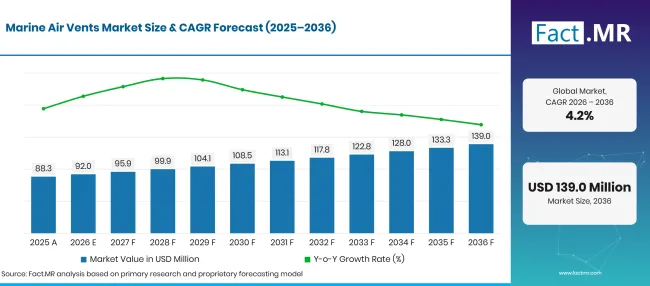
Marine Air Vents Market Forecast Global | Source: Fact.MR
Category
| Category | Segments |
|---|---|
| Product Type | Cowl Vents, Mushroom Vents, Dorade Boxes, Others |
| Material | Stainless Steel, Aluminum, Plastic, Others |
| Application | Commercial Vessels, Recreational Boats, Naval Ships, Others |
| Distribution Channel | Offline, Online |
| Region | United Kingdom; Japan; Germany; United States; Brazil |
Source: Fact.MR analysis. Updated Nov 23, 2026
Source: Fact.MR analysis
Segmental Analysis
What is supporting cowl vents leading position in marine air vent sales?
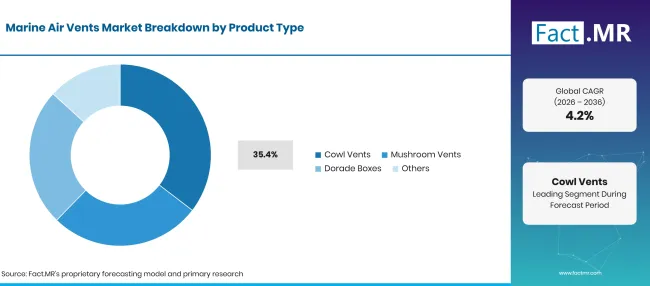
Marine Air Vents Market Breakdown Product Type | Source: Fact.MR
Demand for Cowl vents account for 35.4% of revenue in 2026, about USD 32.6 million, as they scoop air into cabins and engine spaces and can be turned to wind. Mushroom vents and Dorade boxes follow on yachts. Manufacturers are offering stainless and plastic cowls. Similar ventilation needs are projected to keep cowl vents in the lead. The U.S. Coast Guard's vessel ventilation regulations require enclosed spaces to be properly vented or ventilated and provide for closure of ventilation openings during fire emergencies. These requirements reinforce the importance of suitable ventilation fittings across applicable vessels. Manufacturers offering weather-resistant stainless steel and lightweight plastic cowl designs can address different installation and vessel requirements.
Which material characteristics are strengthening stainless steel demand?
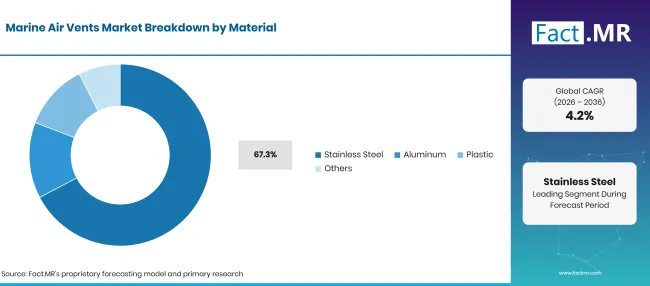
Marine Air Vents Market Breakdown Material | Source: Fact.MR
Sales of Stainless steel accounts for 67.3% of revenue in 2026, about USD 61.9 million, as it resists salt corrosion and suits deck hardware. Aluminum and plastic follow. Manufacturers are using 316 steel. Similar durability needs are projected to keep stainless in the lead. The Bureau of Indian Standards issued implementation guidelines for revised IS 6911:2026 in April 2026, updating requirements for stainless steel plates, sheets and strips, with implementation scheduled from August 18, 2026. Manufacturers using appropriate marine-grade stainless steel, including 316 grades, can target buyers prioritizing durability and reduced replacement requirements.
How are commercial vessel fleets generating demand for marine air vents?
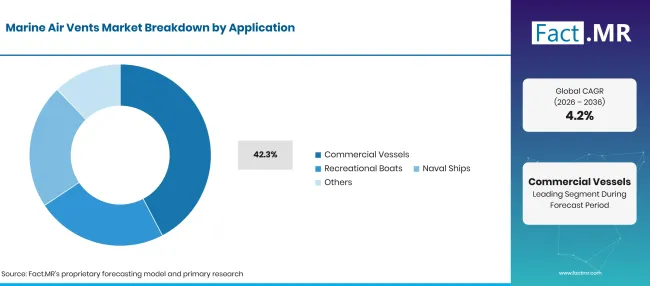
Marine Air Vents Market Breakdown Application | Source: Fact.MR
Demand for Commercial vessels account for 42.3% of revenue in 2026, about USD 38.9 million, as cargo ships and ferries need engine room and hold ventilation. Recreational and naval vessels follow. Manufacturers serve shipyards. Similar fleet needs are projected to keep commercial vessels in the lead. According to UN Trade and Development, the global merchant fleet comprised approximately 116,000 vessels of at least 100 gross tons at the beginning of 2026. Its total carrying capacity reached 2.5 billion deadweight tons, increasing by 85 million deadweight tons compared with the previous year. This expanding fleet provides a substantial installation and maintenance opportunity for marine ventilation suppliers. Shipbuilders and vessel operators therefore represent important customers for durable air vents and replacement ventilation components.
Why does offline distribution lead the Marine Air Vents Market?
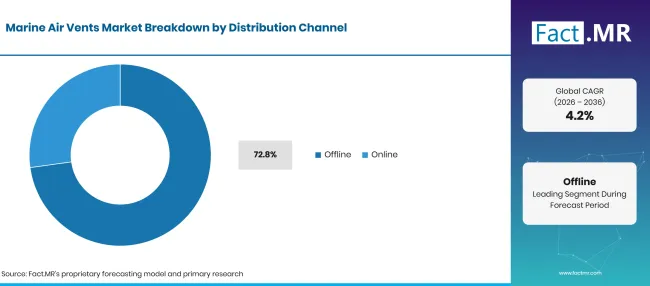
Marine Air Vents Market Breakdown Distribution Channel | Source: Fact.MR
Sales through Offline channels account for 72.8% of revenue in 2026, about USD 67.0 million, as vents are specified by yards and sold through chandleries. Online sales grow. Manufacturers support stores. Similar buying is projected to keep offline in the lead. The UK Maritime and Coastguard Agency's 2025–2026 annual report recorded 1,041 commercial vessels above 100 gross tons on the UK Ship Register as of March 31, 2026. The register also included 4,486 fishing vessels, 33,674 small vessels and 13,901 pleasure vessels. This broad installed vessel base supports continuing requirements for equipment supply, maintenance and replacement. Online platforms improve product discovery, while specialist distributors retain an important role in technical purchasing and after-sales support.
Marine Air Vents Market-Drivers, Restraints & Trends
Drivers: Expansion of Alternative-Fuel Vessel Construction
Demand for marine air vents is gaining support as shipbuilders introduce vessels powered by LNG, methanol and other alternative fuels, increasing the need for appropriately designed ventilation and air-management arrangements in machinery spaces, fuel preparation rooms and enclosed compartments. India's Ministry of Ports, Shipping and Waterways reported on February 18, 2026, that Cochin Shipyard had secured a contract to construct six 1,700-TEU LNG-fuelled container vessels for CMA CGM. Additionally, the Directorate General of Maritime Administration's September 2026 report identified the development of methanol bunkering guidelines and ammonia bunkering guidelines as priorities for India's maritime decarbonization programme. These developments are expanding the technical requirements for safe vessel ventilation and are expected to create opportunities for suppliers of marine air vents, ventilation components and associated safety equipment.
Restraints: High Durability and Limited Replacement Frequency
Sales of marine air vents face constraints because these components are generally designed for extended service under harsh marine conditions, including saltwater exposure, humidity, corrosion and mechanical vibration. Shipowners can extend replacement intervals through periodic inspection, cleaning, coating maintenance and replacement of individual seals or internal components rather than complete vent assemblies. In addition, larger commercial vessels frequently use engineered mechanical ventilation systems, which can reduce reliance on passive ventilation openings in selected enclosed spaces. Marine air vent suppliers must therefore demonstrate corrosion resistance, watertight integrity and compatibility with vessel ventilation arrangements to secure newbuilding and retrofit contracts. These long service intervals and the availability of maintenance alternatives can moderate recurring replacement demand.
Opportunity: Adoption of Solar-Powered Marine Ventilation Systems
Demand for solar-powered marine vents is creating opportunities among recreational boat owners, yacht operators and small-vessel manufacturers seeking ventilation without continuous battery consumption. Solar-powered ventilators can help remove accumulated heat, moisture and odors from cabins, engine compartments and enclosed storage spaces while reducing dependence on conventional electrical systems. The U.S. Coast Guard's 2026 National Recreational Boating Safety Survey initiative covers all 50 states and the District of Columbia, with more than 50,000 households invited to participate. Separately, its latest published recreational vessel registration statistics recorded 11,674,073 registered boats in 2024. This substantial recreational boating base provides a potential customer pool for solar-powered ventilation products, particularly in the aftermarket segment.
Trend: Increasing Demand for Fuel-Specific Ventilation and Safety Systems
Demand for specialized marine ventilation systems is increasing as LNG and methanol gain greater acceptance in commercial shipping and port infrastructure. Vessel operators require ventilation arrangements that account for fuel properties, gas accumulation risks, hazardous-area classification and applicable maritime safety requirements. The U.S. Energy Information Administration reported on September 1, 2026, that American LNG exports averaged 17.4 billion cubic feet per day during the first half of 2026, representing a 23% increase from the corresponding period in 2025. Meanwhile, India's government announced on September 26, 2026, the development of a 150-tonne-per-day port-based e-methanol production facility at Kandla. These developments indicate expanding LNG and methanol supply infrastructure, encouraging shipbuilders and equipment suppliers to incorporate suitable ventilation arrangements into alternative-fuel vessel designs. Similar fuel diversification is projected to support demand for specialized marine ventilation equipment.
Marine Air Vents Market by Analysis by Key Country
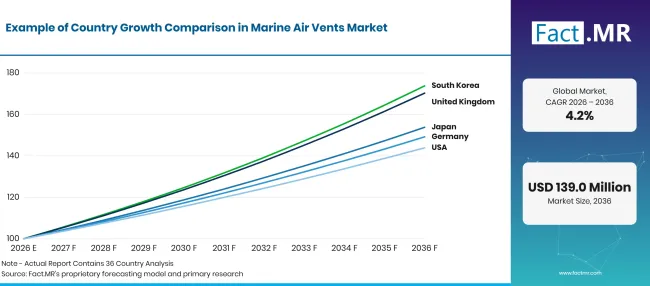
Marine Air Vents Market Growth Index | Source: Fact.MR
| Country | CAGR (2026-2036) |
|---|---|
| United Kingdom | 5.5% |
| Japan | 4.4% |
| Germany | 4.1% |
| United States | 3.7% |
| Brazil | 3.1% |
Source: Fact.MR analysis. Updated Nov 23, 2026
Source: Fact.MR analysis.
Why is the United Kingdom the fastest-growing market for marine air vents?
Demand for marine air vents in the United Kingdom is projected to increase at a 5.5% CAGR, the fastest among the five key countries, as Type 26 and Type 31 frigate builds proceed and yacht builders such as Sunseeker and Princess deliver large motor yachts. Similar programs are projected to drive sales.
In February 2026, the UK Ministry of Defence reported construction milestones for two Type 31 frigates, with the programme sustaining 1,250 skilled jobs and another 1,250 jobs across the domestic supply chain. Additionally, the Ministry of Defence's August 2026 armed forces statistics recorded 52 vessels in the Royal Navy Surface Fleet and 12 in the Royal Fleet Auxiliary as of April 1, 2026. These naval programmes create procurement opportunities for ventilation components used in machinery spaces, accommodation areas and other enclosed vessel compartments.
Which developments are expanding marine air vent demand in Japan?
Demand in Japan is estimated to grow at a 4.4% CAGR as Japanese yards and operators such as NYK develop ammonia- and LNG-fueled ships that need gas-safe ventilation. Similar fuel programs are projected to drive sales in Japan.
The Ministry of Land, Infrastructure, Transport and Tourism maintains monthly shipbuilding statistics covering vessel orders, construction starts, completions and repairs. Its September 2026 shipbuilding survey provides updated indicators of domestic shipyard activity. Separately, Japan's development of ammonia-fueled vessels is creating additional engineering requirements for ventilation and gas-handling systems. NYK's November 2026 ammonia-fueled carrier project illustrates this direction. Demand opportunities are likely to emerge for ventilation systems designed around machinery compartments, fuel-handling areas and vessel-specific safety requirements.
How is Germany's shipbuilding activity influencing marine air vent sales?
Demand in Germany is projected to increase at a 4.1% CAGR as Meyer Werft builds cruise ships and German naval programs proceed.
Everllence, GEA and Siemens supply marine systems. Similar activity is projected to support sales. According to the German Navy's 2026 maritime report, German shipyards delivered 12 vessels in 2025, recorded 13 new orders and maintained an order backlog of 41 vessels valued at EUR 14.3 billion. The report also recorded shipyard deliveries worth EUR 3.4 billion during the year. This order pipeline provides opportunities for suppliers of weatherproof air vents, engine-room ventilation components and corrosion-resistant ventilation assemblies. Meyer Werft and other specialized shipbuilders are important potential customers for marine equipment suppliers serving commercial and naval vessel projects.
What is shaping marine air vent sales in the United States?
Sales of marine air vents in the United States are estimated to grow at a 3.7% CAGR as recreational boat refits create replacement demand while naval yards expand.
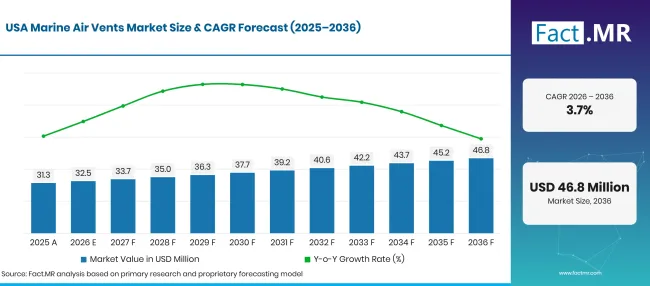
Marine Air Vents Market Forecast Usa | Source: Fact.MR
Similar activity is projected to support sales. In September 2026, the U.S. Navy awarded three prototype agreements to expand Landing Craft Utility production across shipyards in Texas and Alabama. The initial construction obligation totaled approximately USD 280.5 million, with each selected shipyard assigned two or three prototype vessels. The programme aims to strengthen domestic shipbuilding capacity and replace aging landing craft. These developments create potential demand for ventilation equipment across machinery compartments, crew spaces and enclosed technical areas. Recreational boat refits provide an additional replacement opportunity for marine air vent suppliers.
Why is marine air vent growth slower in Brazil?
Demand in Brazil is projected to record a 3.1% CAGR, the slowest among the five key countries, as local shipbuilding is recovering slowly and offshore units are often outfitted abroad.
Similar conditions are projected to keep growth slower. In January 2026, Brazil's Ministry of Ports and Airports announced BRL 1.98 billion in financing for six offshore support vessels, including Platform Supply Vessels (PSVs), with approximately 1,200 direct construction jobs expected. In August 2026, the ministry also reported progress on a BRL 230.2 million project covering two shallow-diving support vessels. These developments support demand for ventilation equipment used in engine rooms, accommodation spaces and technical compartments. Nevertheless, longer shipbuilding and procurement cycles may moderate the pace of market expansion.
Competitive Landscape for Marine Air Vents Market
Competition in the marine air vents market is divided between marine systems groups and building HVAC groups. Wärtsilä, Everllence, Alfa Laval and GEA compete on ship systems, while ABB, Schneider, Honeywell, Emerson, Siemens and Johnson Controls compete on controls and HVAC. Buyers select on certification, durability and integration.
From 2024 onward, competition shifted toward alternative-fuel ventilation. Manufacturers with gas-safe designs are best placed.
Recent Developments
- In 2025, MAN Energy Solutions rebranded as Everllence.
- On May 5, 2026, Wärtsilä introduced a modular grease trap product line for onboard wastewater management. The equipment separates fats, oils and grease from galley wastewater on merchant vessels, cruise ships and offshore platforms.
- On September 2, 2026, Everllence introduced Engine Supported Air Lubrication (ESAL), a technology integrating hull air lubrication with the main engine. The company stated that the system can improve vessel efficiency by up to 6%.
- On February 5, 2025, Alfa Laval announced an agreement to acquire UK-based NRG Marine, a provider of ultrasonic anti-fouling technology for marine, oil and gas and industrial applications. The acquisition expands its marine technology portfolio with solutions designed to reduce fouling and improve equipment efficiency.
- On September 2, 2026, Alfa Laval introduced Hukka-5, a next-generation exhaust gas steam boiler for cruise vessels and passenger ferries. The product uses downward natural circulation to improve waste heat recovery while reducing equipment footprint.
- On November 6, 2026, Alfa Laval entered into an agreement to acquire NAVTOR AS for USD 700 million. The acquisition strengthens its maritime digital solutions portfolio, including e-navigation and vessel performance management. Completion is expected in Q1 2027, subject to regulatory approvals
- In June 2026, ABB announced an agreement to acquire Høglund AS, a Norwegian marine automation specialist. The acquisition was intended to expand ABB's marine automation portfolio.
- On April 27, 2026, Johnson Controls acquired Nantum AI, a company specializing in artificial intelligence algorithms for energy optimization and building control. The acquisition strengthens the OpenBlue digital ecosystem by introducing AI-driven HVAC optimization and real-time airflow management capabilities.
Key Players in Marine Air Vents Market
Key companies operating in the market include Wärtsilä Corporation, Everllence SE, Alfa Laval AB, ABB Ltd., Schneider Electric SE, Honeywell International Inc., Emerson Electric Co., Siemens AG, Johnson Controls International plc, and GEA Group AG.
- Wärtsilä Corporation
- Everllence SE
- Alfa Laval AB
- ABB Ltd.
- Schneider Electric SE
- Honeywell International Inc.
- Emerson Electric Co.
- Siemens AG
- Johnson Controls International plc
- GEA Group AG
Bibliography
- Alfa Laval AB. (2025, February 5). Alfa Laval to acquire NRG Marine to offer innovative ultrasonic anti-fouling solutions to its customers.
- Alfa Laval AB. (2026, September 2). Alfa Laval launches Hukka-5, the next-generation exhaust gas steam boiler.
- Alfa Laval AB. (2026, November 6). Alfa Laval to acquire NAVTOR AS to strengthen the digital offering for the maritime sector.
- Bureau of Indian Standards. (2026, April 23). Guidelines for implementation of revised IS 6911:2026 (Stainless Steel Plate, Sheet and Strip).
- Cochin Shipyard Limited. (2026, February 18). CMA CGM and Cochin Shipyard Limited sign contract for six LNG-fuelled container vessels. Press Information Bureau, Government of India.
- Directorate General of Maritime Administration. (2026, September). DGMA monthly report – September 2026. Government of India.
- Everllence SE. (2025, June 4). MAN Energy Solutions becomes Everllence.
- Everllence SE. (2026, September 2). Everllence introduces ESAL to increase vessel efficiency by up to 6%.
- Government of Brazil, Ministry of Ports and Airports. (2026, January 20). Ministro Silvio Costa Filho anuncia recursos para construção de embarcações em Santa Catarina.
- Government of India, Ministry of Ports, Shipping and Waterways. (2026, September 26). India's first port-based e-methanol production facility to produce and supply green fuel to ships. Press Information Bureau.
- International Maritime Organization. (n.d.). International Convention for the Safety of Life at Sea (SOLAS).
- International Organization for Standardization. (2022). Ships and marine technology—Air-conditioning and ventilation of accommodation spaces and other enclosed compartments on board ships—Design conditions and basis of calculations (ISO Standard No. 7547:2022).
- Japan, Ministry of Land, Infrastructure, Transport and Tourism. (2026). Shipbuilding and ship machinery statistics.
- Johnson Controls International plc. (2026, April 27). Johnson Controls acquires Nantum AI to accelerate AI-driven energy optimization.
- Maritime and Coastguard Agency. (2026). Annual report and accounts 2025–2026. Department for Transport, United Kingdom.
- Ministry of Defence. (2026, February 24). Powerful new Royal Navy warship programme advances as milestones reached for two ships. GOV.UK.
- U.S. Coast Guard. (2025). Recreational boating statistics 2024. U.S. Department of Homeland Security.
- U.S. Coast Guard. (n.d.). Code of Federal Regulations, Title 46: Shipping—Ventilation for closed spaces.
- U.S. Department of the Navy. (2026, September 15). U.S. Navy awards three prototype agreements to accelerate LCU 1700 production.
- U.S. Energy Information Administration. (2026, September 1). U.S. LNG exports rose 23% in the first half of 2026 because of higher capacity.
- UN Trade and Development. (2025). Review of maritime transport 2025: Staying the course in turbulent waters. United Nations.
- UN Trade and Development. (2026). Maritime and other transport: World fleet capacity to carry goods growing steadily.
- Wärtsilä Corporation. (2026, May 5). Wärtsilä introduces a new product line to enhance onboard wastewater management.
Segmentation
Scope of Report
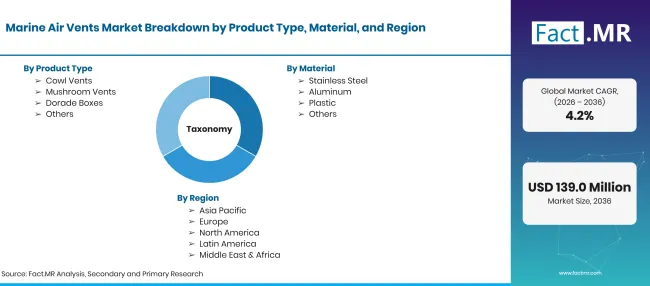
Marine Air Vents Market Taxonomy | Source: Fact.MR
| Items | Values |
|---|---|
| Quantitative Units (2026) | USD 92.0 Million |
| Product Type | Cowl Vents, Mushroom Vents, Dorade Boxes, Others |
| Material | Stainless Steel, Aluminum, Plastic, Others |
| Application | Commercial Vessels, Recreational Boats, Naval Ships, Others |
| Distribution Channel | Offline, Online |
| Regions Covered | North America, Latin America, Europe, Asia Pacific, Middle East & Africa |
| Countries Covered | United States, Germany, Japan, United Kingdom, Brazil, and other countries |
| Key Companies Profiled | Wärtsilä Corporation, Everllence SE, Alfa Laval AB, ABB Ltd., Schneider Electric SE, Honeywell International Inc., Emerson Electric Co., Siemens AG, Johnson Controls International plc, GEA Group AG |
| Additional Attributes | Dollar revenue in the Marine Air Vents Market is segmented by product type (cowl vents, mushroom vents, dorade boxes); material (stainless steel, aluminum, plastic); application (commercial vessels, recreational boats, naval ships); distribution channel (offline, online) and region. |
Source: Fact.MR analysis. Updated Nov 23, 2026
Source: Fact.MR analysis.
Marine Air Vents Market by Segments
-
Product Type
- Cowl Vents
- Mushroom Vents
- Dorade Boxes
- Others
-
Material
- Stainless Steel
- Aluminum
- Plastic
- Others
-
Application
- Commercial Vessels
- Recreational Boats
- Naval Ships
- Others
-
Distribution Channel
- Offline
- Online
-
Region:
- North America
- United States
- Canada
- Mexico
- Europe
- Germany
- United Kingdom
- France
- Italy
- Spain
- Rest of Europe
- Asia Pacific
- China
- India
- Japan
- South Korea
- Australia
- Rest of Asia Pacific
- Latin America
- Brazil
- Argentina
- Rest of Latin America
- Middle East & Africa
- GCC Countries
- South Africa
- Rest of Middle East & Africa
- North America
Frequently Asked Questions
How big is the global Marine Air Vents Market in 2026?
What will be the size of the Marine Air Vents Market by 2036?
How fast will the Marine Air Vents Market grow during the forecast period?
Which product type segment holds the largest share of the Marine Air Vents Market?
Who worked on this report


Preview the report firsthand - request a free sample
Free SampleGet the brochure for pricing and purchase details
Download PDF